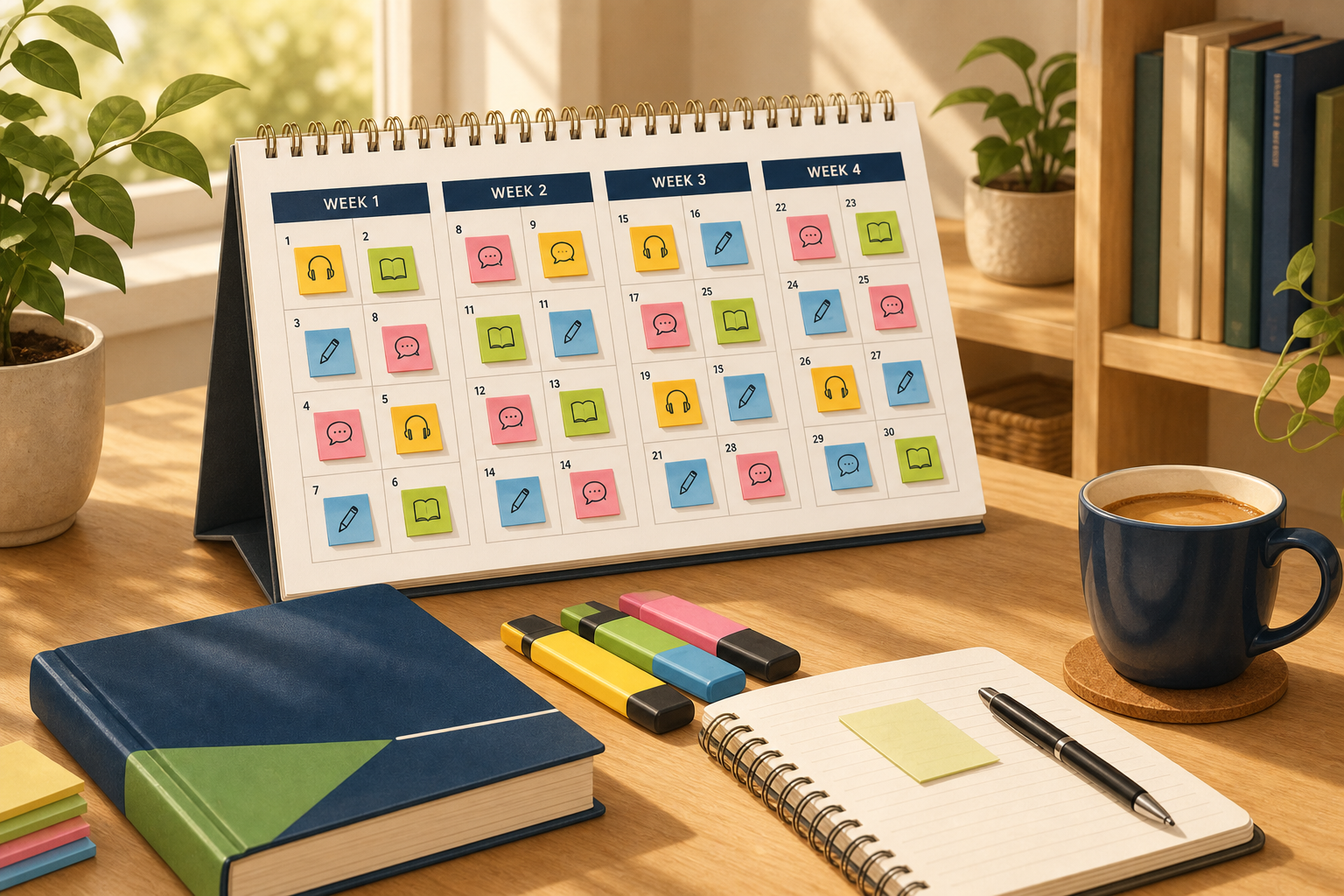
One month is enough time to raise your CELPIP score meaningfully — if you spend it on the right work. You will not master every grammar rule in thirty days, but you can learn the test format, fix recurring errors, and build exam stamina.
This plan assumes you can study about 90 minutes on weekdays and a longer block on weekends. Adjust the timing, but keep the order: diagnose first, fix weak output skills, then integrate full mocks.
Week 1: Diagnose and Learn the Format
Days 1–2: Take a full timed practice test. Record your estimated CLB per skill and list three errors you made in each section.
Days 3–5: Study the official task types. Know how many speaking tasks you face, how long Writing Task 1 vs Task 2 runs, and which listening parts include video or multiple speakers.
Days 6–7: Re-do only your two weakest skills in isolation. For example, complete one speaking task set and one writing task set with feedback if available.
Week 2: Speaking and Writing Deep Dive
Speaking often limits overall results because tasks change quickly and prep time is short. This week, memorize flexible openers and transitions you can adapt to any prompt.
Practise Tasks 1, 2, and 6 first — they appear on almost every test and reward clear structure. Record audio on your phone, then listen for long pauses, off-topic tangents, and flat delivery.
For Writing, draft one email and one survey response per day. Focus on tone: formal for complaints to businesses, neutral for community surveys, warmer for messages to friends.
- Speaking goal: finish every answer without running out of things to say.
- Writing goal: hit every prompt point with at least two sentences each.
- Daily review: note five words or phrases you could upgrade.
Week 3: Listening and Reading Under Time
Shift attention to receptive skills, but do not drop speaking entirely — fifteen minutes of timed responses every other day keeps your momentum.
Listening: practice note-taking for multi-speaker discussions and viewpoint monologues. Write symbols and keywords, not full sentences.
Reading: train scanning. Read the question first, locate the paragraph that likely holds the answer, then verify. You rarely need to understand every line of a passage to score well.
Week 4: Full Mocks and Fine-Tuning
Days 22 and 26: Complete two full-length practice exams under strict conditions. Treat them as dress rehearsals — same chair, no phone, no extra breaks.
Between mocks, review only your error log. If you keep missing inference questions in Listening Part 6, drill that part instead of repeating easy sections.
Days 28–29: Light review of templates and vocabulary. Avoid heavy new material.
Day 30: Rest. Confirm ID requirements, travel time, and what you are allowed to bring into the test centre.
How to Adapt the Plan
If you are already strong in Reading, cut those sessions in half and reinvest the time in Speaking. If your test is CELPIP-General LS, remove Writing and Reading entirely and double Listening and Speaking practice.
The biggest mistake in a one-month sprint is studying randomly. Follow a sequence, measure progress weekly, and let your weakest scored skill dictate where the next hour goes.