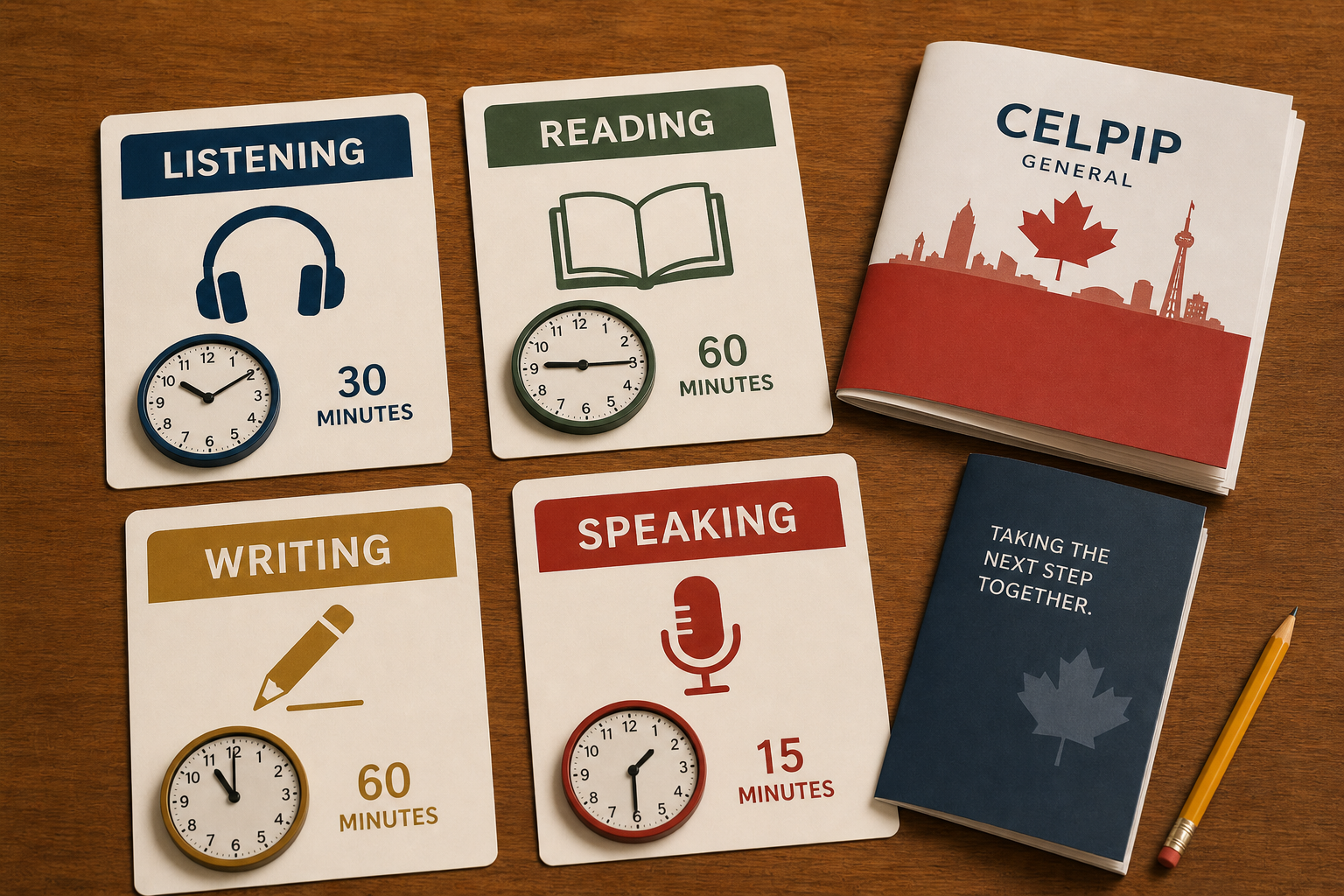
CELPIP-General is a fully computer-delivered English test designed for Canadian immigration and professional contexts. Unlike paper exams, every skill — including Speaking — is recorded through the computer at your test centre.
Knowing the pattern before you book removes surprises on test day. You will sit longer, move faster between tasks, and manage energy better when you understand how the session is structured.
The part names and time ranges below are a PrepHero study summary of the public format. They are not copied from an official booklet, and they are not official test questions. Confirm the current timing on celpip.ca before test day.
The Four CELPIP Sections at a Glance
CELPIP-General scores four skills: Listening, Reading, Writing, and Speaking. Each skill maps to Canadian Language Benchmark (CLB) levels that IRCC uses for Express Entry and many provincial programs.
- Listening — 47–55 minutes, 6 parts, 38–54 questions
- Reading — 55–60 minutes, 4 parts, 38 questions
- Writing — 53–60 minutes, 2 tasks (email + opinion response)
- Speaking — 15–20 minutes, 8 tasks with short prep time each
Listening: Parts and Question Types
Part 1 (Problem Solving) presents a short conversation about an everyday problem — lost delivery, scheduling conflict, service issue. You answer multiple-choice questions about what was decided.
Part 2 (Daily Life Conversation) tests informal dialogue between two people. Part 3 (Information) uses a short talk or announcement with factual questions.
Part 4 (News Item) is a fast news report — note-taking matters. Part 5 (Discussion) involves three speakers; track who said what. Part 6 (Viewpoints) is a longer monologue where you infer attitude and main ideas.
Reading: Parts and Question Types
Part 1 (Correspondence) gives an email or letter plus a reply template with blanks to fill.
Part 2 (Apply a Diagram) pairs a notice or webpage with a chart, map, or schedule — you match information across sources.
Part 3 (Information) asks you to match paragraphs to statements. Part 4 (Viewpoints) presents two writers with different opinions; questions test detail and inference.
Writing and Speaking Tasks
Writing Task 1 requires an email (~150–200 words) responding to a scenario — complaint, invitation, request, or update. Task 2 presents two options (often a survey or policy choice); you pick one side and defend it (~150–200 words).
Speaking includes eight timed tasks: give advice, tell a personal story, describe a scene, make predictions, compare and persuade, handle a difficult situation, express an opinion, and describe an unusual situation. Prep time ranges from 30 to 60 seconds; responses run 60–90 seconds.
How the Session Flows on Test Day
Skills are completed in a fixed order: Listening, then Reading, then Writing, then Speaking. Short breaks may be offered between modules depending on your centre.
You cannot revisit Listening audio or skip ahead freely — the system controls pacing. Reading and Writing allow navigation within the section, but the overall clock keeps moving.
Treat your first full mock test as a dress rehearsal for this flow. Familiarity with transitions between skills is one of the cheapest score improvements available.