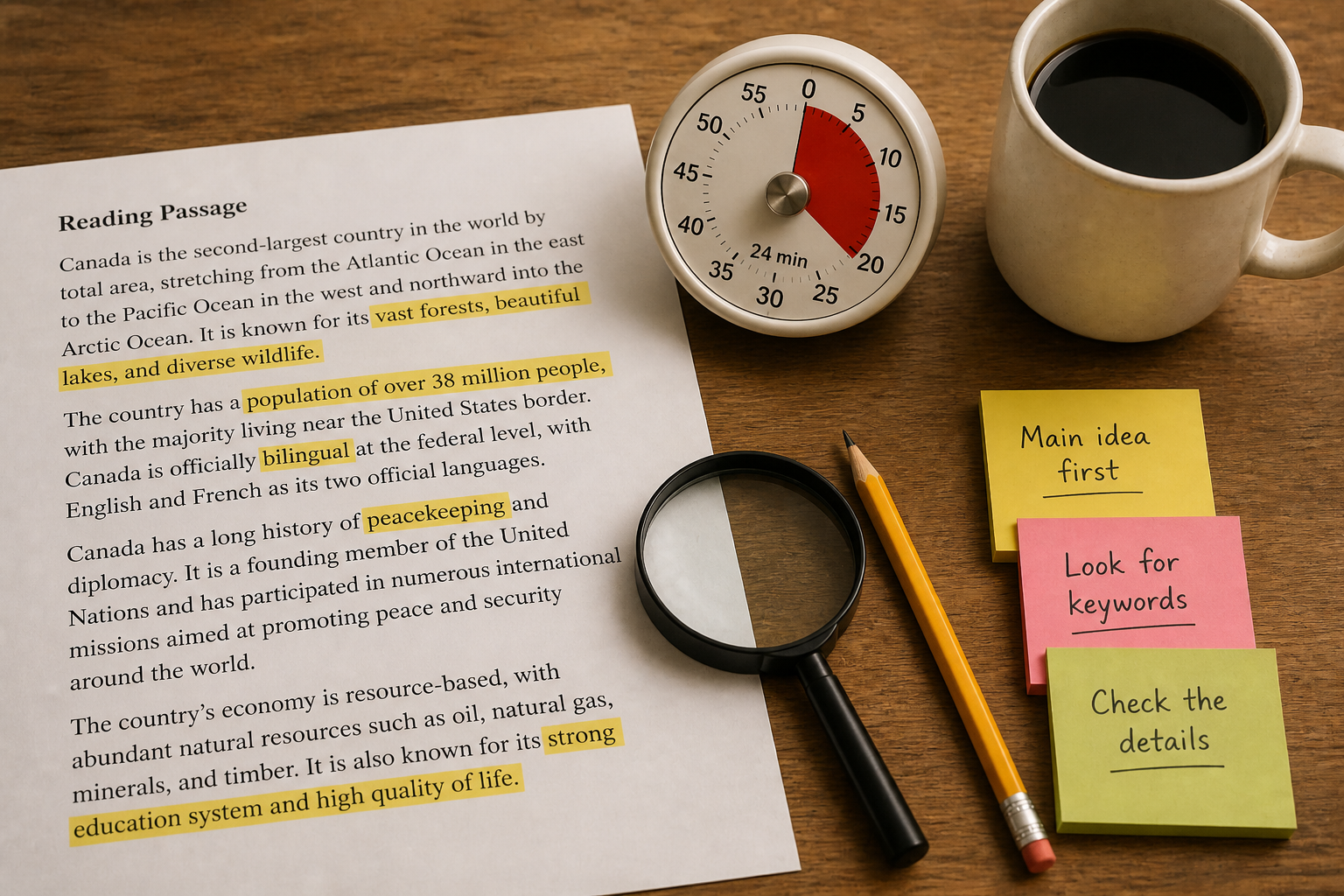
CELPIP Reading rewards speed and accuracy together. You have roughly 55–60 minutes for four parts and 38 questions — not enough time to read every word slowly.
Strong readers on this test skim for structure, scan for keywords, and resist the urge to translate or re-read entire paragraphs.
Skim First: Understand the Shape of the Text
Skimming means reading headings, first sentences, dates, and names to learn what the passage is about and how it is organized.
In correspondence tasks, skim the email chain to identify sender, purpose, and tone before tackling blanks. In viewpoint passages, skim each writer’s opening paragraph to learn their position.
Scan Second: Hunt the Answer
Scanning is targeted searching — once you know what a question asks, locate the section that likely holds the answer and read that zone carefully.
Watch for paraphrasing: correct options restate the passage rather than copy it word for word. If an answer choice repeats a phrase verbatim, verify it is not a trap.
Part-by-Part Tactics
Part 1 (Correspondence): read the reply prompt first so you know what the blanks must express — grammar and logic eliminate wrong choices quickly.
Part 2 (Diagram): study the visual before the text — charts and schedules give you anchors for where facts live.
Part 3 (Information): treat it like matching — identify unique keywords in each paragraph. Part 4 (Viewpoints): build a mental table of Writer A vs Writer B positions.
Time Budget That Works
Divide the section into four blocks and stick to them. If a question stalls you for more than 90 seconds, mark your best guess and move on.
Easier points later in the test still count the same — do not donate five minutes to a single hard item in Part 1.
- Part 1: ~14 minutes
- Part 2: ~14 minutes
- Part 3: ~13 minutes
- Part 4: ~14 minutes plus review buffer
Build Speed in Practice
Drill one part at a time under a strict timer. Track which question types slow you down — blank-fill, matching, or inference.
Reading Canadian news, municipal notices, and workplace emails in English builds background knowledge that makes skimming faster on unfamiliar topics.